Satire as a Tool for Social Change: What It Can—and Can’t—Do
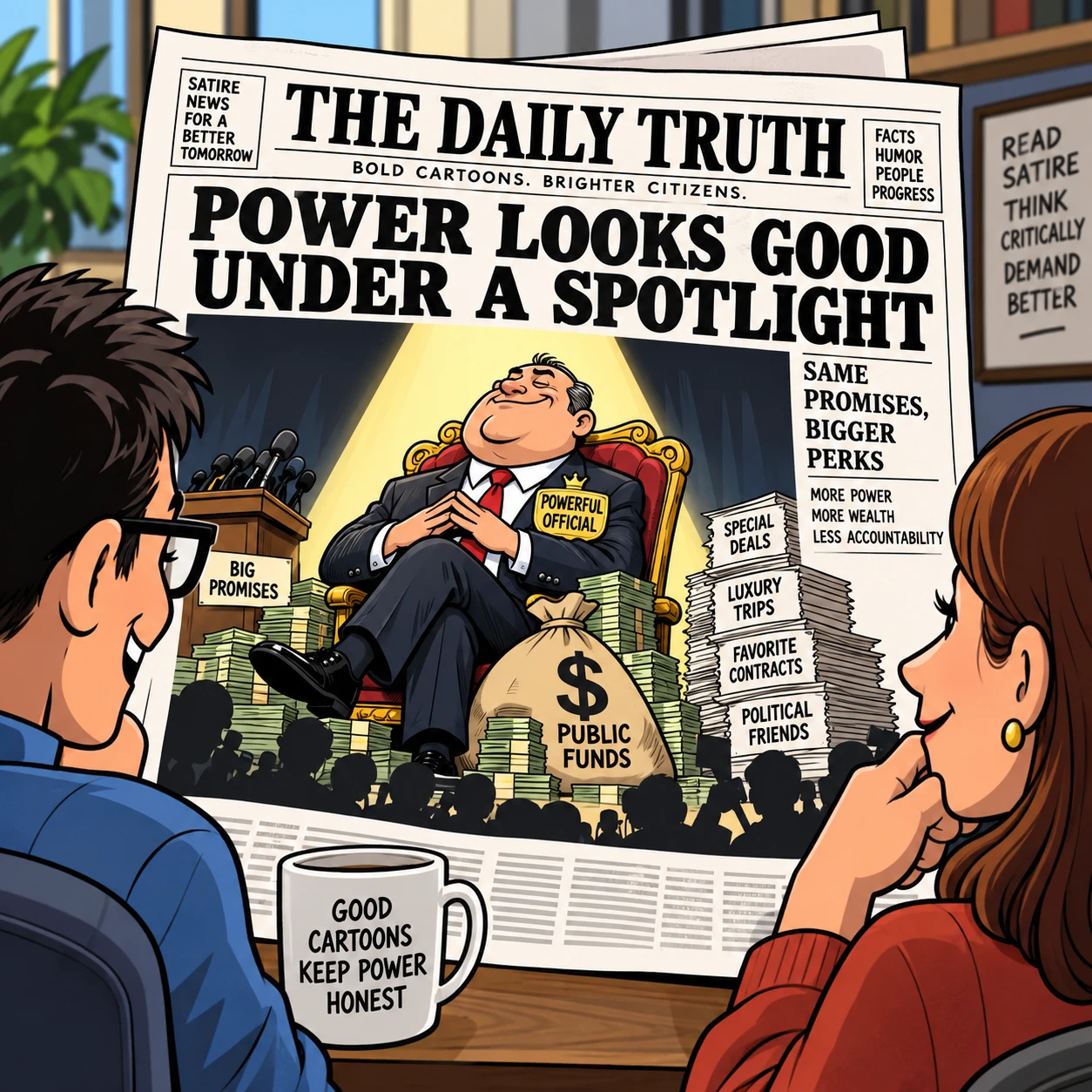
Satire can make public issues easier to notice, question, and discuss. By using humor, irony, or exaggeration to expose contradictions, it can challenge power and authority. But a joke rarely changes a law or public attitude on its own. Its effects depend on who encounters it, how they interpret it, and whether awareness leads to discussion or civic engagement.
What Makes Satire a Form of Social Commentary?
Satire is a form of social commentary that uses humor, irony, or exaggeration to expose flaws in people, institutions, or accepted ideas. It invites an audience to scrutinize a subject rather than take its claims at face value.
Political satire often targets public officials, policies, political parties, and the language used to defend them. A satirical sketch might depict a city official cutting a ceremonial ribbon on a pothole, while insisting that the road is now “fully improved.” The joke points to a gap between an official claim and residents’ experience. The exaggerated scene is invented; the underlying policy question may still deserve serious investigation.
That distinction matters. Satire is not simply comedy about current events, and it is not a license to make any claim without evidence. Strong social commentary gives an audience enough context to recognize the target and understand what is being criticized. Humor can lower the barrier to attention, but the criticism carries the argument.
Satire may challenge power and authority by making grand claims look absurd, or by showing how ordinary people bear the cost of a decision. Its target can also be public behavior, media conventions, or social norms. The approach is most persuasive when the joke punches at a decision-maker or system with influence, rather than using vulnerable people as the punchline.
How Satire Can Spark Awareness and Conversation
Satire can spark awareness by presenting a complex or overlooked issue in a memorable, accessible form. A comic frame may give people an opening to discuss subjects they would otherwise avoid.
For example, imagine a clearly labeled satirical report about a fictional “Department of Waiting,” where residents must submit a form to ask why their previous forms remain unanswered. The scenario could make bureaucratic delays easier to picture and talk about. It does not establish that a specific agency has failed; readers would need reporting, documents, or reliable data to assess any real-world claim.
Humor can also help people recognize contradictions. A sharp parody of political messaging may prompt readers to ask what a slogan leaves out, who benefits from a policy, or whether a public promise matches measurable results. That is one way satire can influence public opinion: it can make a frame or criticism memorable and invite people to reconsider an issue.
But attention is not the same as understanding. A joke may spread because it is entertaining, while its context disappears when it is reposted. Audiences may also interpret the same satire differently, depending on their beliefs, knowledge, and trust in the source. Writers can improve the odds of productive discussion by making the target clear and linking the humor to a recognizable issue without pretending the joke proves a factual claim.
From Awareness to Social Change
Satire can contribute to social change when awareness leads to reflection, debate, and action, but it cannot guarantee any of those steps. Its role is usually one part of a wider process involving evidence, organizing, journalism, and civic engagement.
A useful way to understand the possible path is the attention-to-action chain:
- Notice: Humor draws attention to a concern or contradiction.
- Interpret: The audience understands what is being criticized and why it matters.
- Discuss: People compare the satire with facts, experiences, or other perspectives.
- Act: Some may share verified information, contact representatives, attend a meeting, support a campaign, or vote.
The chain can break at any point. Someone may enjoy a sketch without recognizing its target. Another person may agree with the criticism but lack the time, access, or resources to act. Satire can also reinforce an audience’s existing views instead of changing them. That can still strengthen a sense of shared concern, but it is not proof that broader opinion has shifted.
Social change typically involves sustained effort and decisions by people and institutions. Satire may help keep an issue visible or give a movement memorable language. It works best alongside factual reporting and the practical work of civic groups, affected communities, and policymakers. Treating a viral joke as evidence of impact overstates what humor alone can do.
The Limits and Risks of Satire
Satire has limits because audiences can misread it, dismiss it, or use it to reinforce harmful ideas. Its effectiveness depends on context, target, and the relationship between the joke and the people it affects.
One common limitation is preaching to the converted. A joke that mocks a position may earn approval from people who already oppose it, while persuading no one who holds that position. If the goal is broader discussion, writers may need to reveal a contradiction clearly rather than rely on an audience sharing the same assumptions.
Misinterpretation is another risk. A satirical headline can be copied without its label or shared by someone who assumes it is real. In other cases, a reader may recognize the joke but miss the serious issue beneath it. Clear labeling and accessible context reduce confusion, though they cannot prevent every misleading repost.
Satire can also reinforce stereotypes or trivialize harm. A joke aimed at a marginalized group may reproduce the very prejudice it claims to criticize, especially if the audience cannot tell who is being mocked. Exaggeration can expose an injustice, but it can also make real suffering seem like a prop. Writers should ask who holds power, who bears the consequences, and who is likely to be the punchline.
Finally, comic framing can obscure facts. A memorable line might travel farther than a correction or a careful explanation. When satire draws on real events, factual details should be checked and separated from invented elements so readers can tell where commentary ends and reporting begins.
Satire, Facts, and Media Literacy
Media literacy helps readers distinguish satire from factual reporting by asking who published a claim, what evidence supports it, and whether the piece signals that it is fictional or comic. A surprising headline should prompt a context check before it is shared as news.
Satire and misinformation are different in purpose, but they can look similar when context is missing. Satire uses invented or distorted elements to criticize a subject, ideally with signals that help audiences recognize the joke. Misinformation is false or inaccurate information shared without regard to its truth; deliberate deception is often called disinformation. A satirical post can still contribute to misinformation if readers mistake it for a factual report or circulate it without its framing.
Use this quick check when a satirical news item makes a specific claim:
- Check the source: Read the site’s description and look for an explicit satire label. A disclaimer helps, but it is not proof that every detail is accurate.
- Find the original: Reposts and cropped screenshots often remove context, date, and author information.
- Verify real-world claims: Search for corroboration from reputable news outlets, official records, or primary documents.
- Separate joke from evidence: Treat invented dialogue, scenes, and statistics as part of the satire unless independently verified.
- Pause before sharing: If the post could be mistaken for a factual alert, add context or avoid reposting it as news.
For fact-checkers and satirical publishers, the same principle applies: label fiction clearly, identify the real subject when appropriate, and link factual claims to evidence. Readers can consult resources such as the Library of Congress guide to primary sources to learn how original documents can help verify historical or public claims. A satirical story may raise a question; it should not substitute for checking the answer.
Using Satire Responsibly
Responsible satire makes its purpose legible, targets conduct or power with care, and avoids presenting invented details as verified news. Writers and readers can preserve the humor while reducing the risk of confusion and harm.
For writers, a practical test is purpose, target, and context:
- Purpose: Decide what idea, contradiction, or decision the piece examines. If the aim is criticism, make that criticism discernible beneath the joke.
- Target: Direct the humor toward people or institutions with power over the issue. Review whether a vulnerable group becomes the punchline instead.
- Context: Label the piece as satire in a place readers will see, and distinguish invented scenes from factual details. Check dates, names, quotations, and any real statistics used.
Readers can apply a similar discipline. Before sharing a comic post, ask whether a person outside the original audience could mistake it for breaking news. If so, provide clear context or do not share it as a factual claim. When the subject involves public health, elections, emergencies, or allegations about an identifiable person, verify details with reliable sources before drawing conclusions.
Satire earns its place in public debate when it makes scrutiny easier without pretending that a punchline settles the facts. It can expose contradictions, invite conversation, and help people pay attention. Lasting social change still depends on what people and institutions do after the laughter fades.
Frequently Asked Questions
Can satire actually change people’s opinions? Sometimes, but its effects vary. Satire may make an issue memorable or encourage reflection, yet audiences often interpret it through existing beliefs. A change in opinion cannot be assumed from a laugh, a share, or a viral post.
How is satire different from misinformation? Satire uses humor or exaggeration to criticize, while misinformation is false or inaccurate information shared without regard for its truth. Satire can be mistaken for misinformation when labels and context are missing.
Why do some people mistake satire for real news? Readers may encounter a cropped screenshot, unfamiliar publication, or headline stripped of its satire label. Realistic writing and fast-moving social feeds can make context harder to notice.
What makes satire responsible or harmful? Responsible satire makes its intent reasonably clear, checks factual details, and targets conduct or power without turning vulnerable people into props. Satire becomes harmful when it misleads audiences, reinforces stereotypes, or obscures real harm.