The Role of Memes in Modern Political Satire
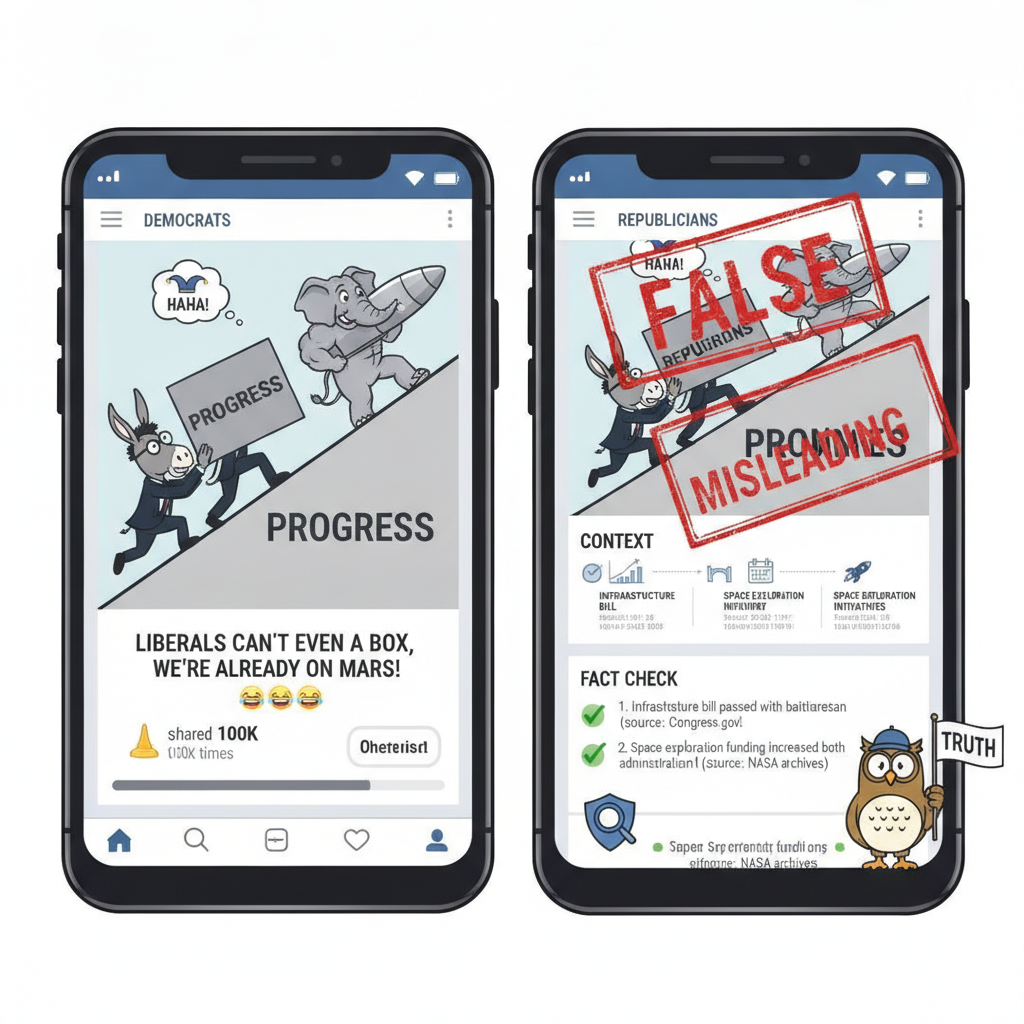
A politician’s awkward pause, a cropped photograph, or a familiar movie still can become political commentary in a matter of minutes. Internet memes compress jokes, opinions, and cultural references into a format people can recognize and share quickly. That makes them a vivid part of modern political satire, but a joke is not automatically accurate, fair, or easy to interpret.
Understanding political memes means looking at both what they make people laugh at and what claims they ask people to accept. Context matters: satire can help audiences question power, while misleading captions or edited images can make falsehoods look credible.
What Makes a Meme Political Satire?
A political meme becomes satire when it uses humor, parody, or exaggeration to comment on political people, institutions, policies, or events. Its meaning often depends on shared references and a visual punchline, rather than a full explanation.
Memes use visual rhetoric: the arrangement of an image, caption, and familiar symbol to make an argument. A photograph of a candidate paired with an absurdly dramatic movie quote might mock a campaign’s messaging. A chart with deliberately ridiculous labels might parody a public official’s explanation. The humor signals that the content is not straightforward reporting, though it does not always make the target or claim clear.
Shared references give a meme its speed. Viewers who recognize a television scene or a recent news clip can grasp the joke almost instantly. Those who lack that context may read it literally or miss its political target. Parody can expose contradictions, puncture polished public relations, or give people a low-cost way to express frustration. It can also oversimplify a complicated issue into a villain, a hero, and a punchline.
That distinction matters for a satirical news audience: satire communicates a viewpoint, while factual reporting establishes what happened using evidence. A meme may do the first effectively without doing the second at all.
Why Memes Fit the Social Media Age
Memes fit social media because they are brief, visual, easy to adapt, and suited to fast-moving online conversations. A single template can be revised to respond to a speech, debate, court decision, or breaking headline within minutes.
On social media platforms, a meme can travel through reposts, comments, group chats, and recommendation feeds. Each person who shares it can add a new caption or apply the format to a different political story. This adaptability helps the joke reach audiences outside the creator’s original circle, but it can also detach the image from its source and original meaning.
The format rewards quick recognition. People often encounter political communication while scrolling between personal updates and entertainment, not while reading a policy paper. A meme can offer an immediate emotional cue: ridicule, anger, solidarity, or disbelief. That is part of its appeal and its limitation. A striking joke may be memorable even when the underlying issue requires more detail than the format can provide.
Speed also puts pressure on accuracy. A meme made during a developing story may circulate before the facts are settled. A later correction may not travel as far as the original joke. The platform mechanics that make memes timely and participatory can therefore make their context fragile.
How Political Memes Shape Public Conversation
Political memes shape public conversation by framing issues, signaling viewpoints, and inviting people to participate. They can make an argument more visible, but a meme’s popularity alone does not prove that it changed anyone’s political opinion.
A meme frames an issue by selecting what to emphasize. One image might portray a policy as wasteful; another might cast the same policy as necessary. Neither format gives the viewer the full record. Instead, each offers a compact interpretation that can prompt discussion, reinforce an existing belief, or encourage someone to look for more information.
Memes also lower the barrier to political expression. Someone who would not write an essay about a tax proposal may share a joke about it or alter a familiar template. That participation can create a sense of community among people who recognize the reference. It may also sharpen group boundaries when a joke depends on mocking political opponents or treating disagreement as evidence of stupidity.
How much influence a meme has depends on its audience and context. A joke shared among friends may serve mainly as social bonding; the same image circulated widely during a campaign may become part of a larger political message. Reach is not the same as persuasion, and engagement counts cannot reveal whether viewers believed, rejected, or simply enjoyed the post.
The Line Between Satire and Misinformation
The line between satire and misinformation depends on how a post is presented, what claims it makes, and whether viewers can recognize its context. A joke can include a false statement without intending to deceive, but it can still mislead when shared as fact.
Political memes often combine an authentic image with a misleading caption, use an edited photograph, or remove a quote from its original setting. A clearly absurd parody may be understood as humor by its first audience. When someone reposts it without the satirical label or surrounding discussion, later viewers may mistake it for a real announcement or a verified quotation.
Intent and impact are different questions. A creator may intend a joke, while a viewer treats the image as evidence. Conversely, an angry or exaggerated meme is not necessarily misinformation just because it expresses a strong opinion. The key is to separate verifiable claims from interpretation: Did the official say those words? Was the image taken when the caption claims? Is a numerical claim supported by a reliable source?
Satire is not a substitute for reporting, and fact-checking cannot determine whether a joke is funny or fair. It can, however, establish whether the factual material inside the joke is authentic. That distinction helps audiences discuss the satire without accidentally spreading a false claim.
Fact-Checking Political Memes
To fact-check a political meme, identify its specific claims, trace the image and wording to their original sources, verify the context, and compare factual assertions with reliable evidence. Treat satire and factual accuracy as related but separate questions.
Use this practical sequence before sharing a meme that includes a quote, statistic, photograph, or news claim:
- Separate the joke from the claim. Write down what the meme literally asserts. “This policy is absurd” is an opinion; “the policy costs $10 billion” is a checkable claim.
- Find the original material. Search for the full speech, post, document, or image rather than relying on a screenshot. Reverse image search can help locate earlier versions of a photograph.
- Check date and context. Look for when and where the image was taken, what came before and after a quotation, and whether the post refers to a current event or an older one.
- Compare credible sources. For claims about legislation or government data, consult primary documents or official sources. Independent reporting and fact-checking organizations can help explain contested details.
- Label uncertainty honestly. If you cannot verify a claim, avoid presenting it as confirmed. A satirical label helps, but it does not repair a false factual assertion.
For example, if a meme attributes a startling sentence to a public official, search the exact wording and inspect the full transcript or recording. If the quote appears only in reposts, that is a reason to pause, not proof that the quote is fabricated. Source tracing beats confidence: a convincing design, a familiar logo, or a large number of shares does not establish authenticity.
Fact-checking can also benefit from media literacy: noticing how framing, cropping, and emotional language influence interpretation. The aim is not to ban political humor. It is to prevent an unverified detail from acquiring credibility simply because it arrived wrapped in a joke.
Reading Memes Critically
You can enjoy political memes critically by identifying their target, separating humor from factual claims, and checking the context before sharing. This approach preserves the fun of satire while reducing the chance of mistaking a punchline for evidence.
Try a quick three-part check: Who is the target? What claim is being made? What context is missing? If the target is unclear, the claim is specific, or the source is absent, look for the original material before treating the post as informative.
Keep an eye on your own expectations, too. A meme that confirms your view may feel more credible than one that challenges it, but agreement is not verification. Consider whether the image is parody, commentary, or an attempt to pass a factual assertion as news. When sharing, preserve useful context and avoid adding a caption that changes the meaning.
Political memes are a flexible form of political communication: they can mock authority, summarize a mood, and invite conversation in a few seconds. Their limits are just as real. They rarely provide the evidence or nuance needed to understand a policy or event on their own. Read the joke as a viewpoint, check its factual ingredients, and turn to reliable reporting when the issue matters beyond the punchline.